Mud City Press

THE FUTURE IS NOT WHAT IT USED TO BE

In the mid-1970s, just about thirty years ago, an environmental activist by the name of Sam Love toured the United States with a multimedia lecture entitled Visions of Tomorrow. The image in the banner above comes from one of his fliers. The point of Love's presentation was that the way we imagined the future was changing. In the 1950s, we saw the future much like the cover of a science fiction magazine. The vision was of flying cars, food in a tablet, household robots, domed cities, and floating skyscrapers, something like what Hanna-Barbera portrayed in the cartoon show "The Jetsons." Then in the 1960s and 70s, as the age of environmentalism was dawning, that image of the future gradually suffered through some serious reality checks. With the increased awareness for toxic wastes and air quality, with the first alarms for population growth and global warming, the bright vision of the future was compromised by concerns for energy woes, food shortages, and shrinking natural resources. Two new futures loomed: one of environmental degradation and economic recession and one of low-tech energy creation and conservation, windmills, photovoltaic cells, passive heating and cooling, increased bicycle use, neighborhood organic gardens, and recycling everything.

THE GREEN WHITE HOUSE

White House

The ensuing years have served to verify what Sam Love was saying in the 1970s. We are not where we thought we would be today. Or, as Sam Love would say, "The future is not what it used to be." Denial regarding energy management, topsoil loss, forest harvest, and greenhouses gases has darkened the backdrop of that Jetsons cartoon. What lies ahead is either increased global turmoil over petroleum reserves and food supplies or a wholesale realignment of the way we live; an age of excess and urban sprawl exchanged for an era of strict conservation and relocalized agriculture.

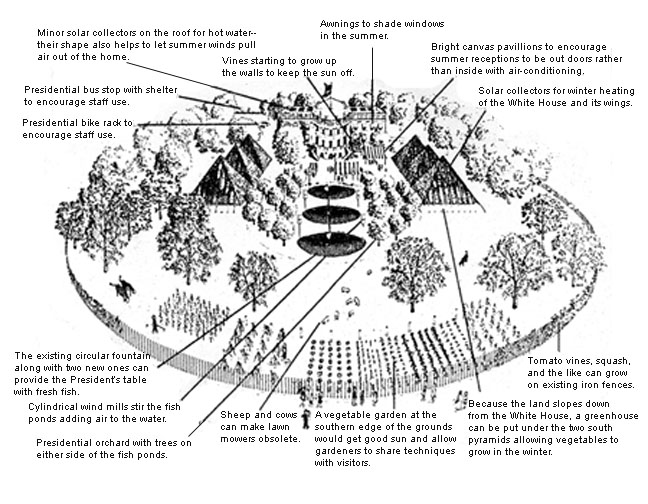
Above is an image that Sam Love included in his multimedia lecture. It is his vision of the White House gone green. Though thirty years have passed since Love first presented this design for 1600 Pennsylvania Avenue, it encapsulates very much of what current environmentalists preach today. The truth is that little has changed in the vision for a sustainable future, except our failure to bring it about.

Perhaps nothing demonstrates the situation, the denial and the unfulfilled vision of the early days of environmental concern, more than the mindset of the administration that last occupied the White House. George Bush filled his cabinet with executives from the petroleum industry. Top to bottom we saw a domestic agenda set on rolling back pollution controls, eliminating forestry regulations, and a voodoo-like manipulation of scientific knowledge. Foreign policy was impossibly worse. The Bush-Cheney administration set a course for war and occupation in the oil producing regions of the world. Rather than contain a lifestyle gone crazy, the United States decided to militarize to ensure we could consume more.

Consider the philosophical differences implied by the green White House above. Instead of an administration set on divisive action and the spread of military bases in the Middle East and Central Asia, we might have a world gathered in positive action, combating global warming, confronting difficult changes in the way we tend the land and harvest the sea, and using the green Earth Day flag as a unifying banner for all men, women, and children. To some this may sound naïve, even childlike in its hope; so be it. But the doubters are answering to a self-fulfilling prophecy of militarism. The paradigm of empire and the unquestioned necessity of an economy based on conflict, not community, is a leftover from an age gone by. Our vision of tomorrow can not be stuck in yesterday's future. If we can't even imagine a world deep in the throes of peace, it will never happen.

Let's hope President Obama will have the imagination to turn the White House green.

Mud City Press Books

It's a few years from now, and the human and environmental costs of industrial farming have finally caught up with America's family farmers. Instead of throwing in the hoe, farmers across the Heartland rise up against the combine, threatening to burn their crops rather than continue the petrochemical assault on the land. (R) Read synopsis and/or sample chapters. BUY NOW at iUniverse or Amazon.com.

Prairie Fire

Click on bookcover to read more about this novel from Mud City Press.