Securing Global Food Resources
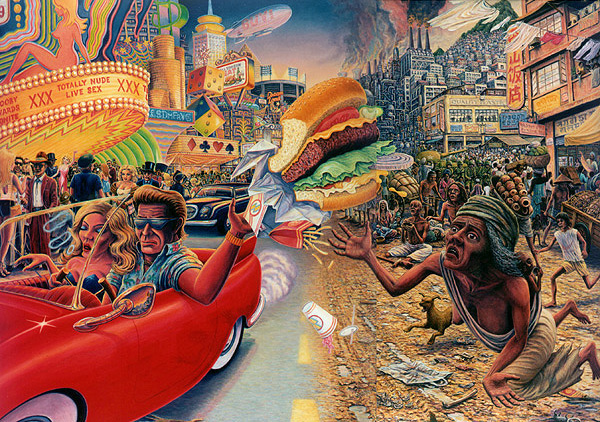
All the forces that come to bear in the challenge of guiding humankind into a new age of either global prosperity or harsh austerity are made manifest in meeting life's most basic of needs–food. Enmeshed within the food production matrix, two unassailable trends stand out in Malthusian clarity. The amount of arable land on the planet is steadily decreasing at approximately one percent a year, while the populace is steadily increasing at a rate of 1.14 percent or 75 million people per year. There is good reason to believe that by the latter half of this century, when the global population is expected to peak between nine and eleven billion, our children and their children must anticipate, if we have not properly prepared for, some kind of general food crisis. In spite of this inevitability, our growth-based economy hungers on, cutting into arable land with highways and shopping malls, recklessly wasting topsoil with industrial agriculture, and draining the aquifers as if there were no tomorrow. If common sense cannot triumph over profit motive, maybe there won't be a tomorrow–or at least not the one we would want.
The carrying capacity of Earth is defined as the number of humans that can live sustainably on the planet. That is, live in equilibrium with themselves and Earth's natural resources indefinitely. This numerical population limit or carrying capacity is a function of a wide array of variables, all directly related to the standard of living the populace chooses. More can live with less. Less can live with more. The most basic standard of life is measured by what a populace eats. The United Nations Food and Agriculture Organization (FAO) uses 2,700 calories per day as a baseline figure for an individual's required nourishment. To enable this level of caloric intake for each and every human indefinitely, involves close management of the way we tend the land. Conservation of water, soil, and biodiversity is absolutely critical to the long-term health of the planet and those who live on it.
Table of Contents
Overviews:
- BACKGROUND
- One of the first serious studies of humans as a global entity came from Thomas Malthus in 1798 in his "Essay on the Principles of Population," when he wrote that human population would one day be limited by the planet's capacity to produce food. But it wasn't until August 6, 1945, when the Enola Gay dropped the first atomic bomb on Hiroshima, that global awareness truly came of age. A new measure of humankind on a small planet became terrifyingly obvious that day. The interconnectedness of all society clarified, and a new kind of thought became fashionable: world economic policy, united nations, world banks, and think tanks. This was the prelude to the awakening of environmental awareness. MORE.
- PEOPLE
- The equation for providing sustainable food resources on Earth begins with the number of people inhabiting the planet. Clearly less people would be able to live with more, and more people would have to live with less. Thus the optimal number of people for the planet is a function of life quality and sustainability. Right now Earth's populaton is six and a half billion and counting. In his book "How Many People Can the World Support," demographer Joel E. Cohen makes the argument that the optimum number is five billion people. Dale Allen Pfeiffer, in his book "Eating Fossil Fuels", drops that down to two billion. Others believe that population, like the price of bread, is regulated by the market, supply of food versus human demand, a kind of economic survival of the fittest. As we have already begun to feel the press of natural resources, conscious stewardship of the planet would suggest determining an optimum population for our situation and guiding the world to that number. MORE.
- ARABLE LAND
- Arable land, land that is suitable for farming, is at a premium. Over the last fifteen years our population has grown while our quantity of arable land has diminished. We have been forced to increase yield per acre to keep up with demand. To do this we have turned to industrial agriculture–the use of petrochemical fertilizers, large scale irrigation, and monoculture. These methods, while highly productive, have proven wasteful in terms of topsoil loss, water quality, and energy input. In a word, it is unsustainable. The way we farm must change. MORE.
- WATER
- The planet and its atmosphere hold an essentially constant quantity of water, 1.45 trillion cubic kilometers of it! Though it is used over and over again, changes form, passes through human bodies, through animals, through plants, through the soil, through the atmosphere, it never really goes away or leaves our biosphere. The water is literally recycled naturally in a process called the hydrologic cycle. Open water evaporation, mostly from the oceans, creates moisture content in the atmosphere. It condenses as it cools and falls back to the earth as rain or snow. When it reaches the earth, it flows downhill, in rivers and streams, is dipped into by all living things, and returns to the ocean, to be evaporated again into the atmosphere. Ideal water management involves humans learning to take part in the water cycle with the least interference. This focuses primarly on our management of waste water. Whatever we put into biosphere enters the water system and invariably gets cycled through the atmosphere and the food chain right back through us. MORE.
- BIODIVERSITY
- Earth is very much a garden planet, a veritable living paradise. It gives rise to all variety of grains, fruits, vegetables, nuts, and a vast array of animal life and insects. All life from invisible bacteria to the one hundred ton blue whale is interconnected through the food chain. To some large extent, the food chain is the process of recycling one life form through and into another. One of the fundamental principles in this system is that variety creates stability. Variety in life forms, often referred to as biodiversity, increases chances for adaptability and deepens the gene pool for evolutionary success during crisis, for example, a changing climate. The more participants there are in the community of life, the more secure the entire community becomes. MORE
- CLIMATE
- Over the course of the last one hundred years, industrial and automotive emissions from the burning of fossil fuels have changed the chemistry of our atmosphere which in turn has altered the balance of Earth's exchange of heat with the Sun. As a result, the planet is warming, and we face unknown changes in the climate. These changes hold the potential to alter critical biological and ecological relationships for every living thing on the planet and are very likely to impact food security, either by catastrophic weather events, blight, or insect infestation. With these potentials hovering like tornadoes just over the horizon, reducing our use of fossil fuels and thus our greenhouse gas emissions makes a lot of sense right now. Add concerns for peaking oil production, and at a bare minimum, conservation of petroleum should have begun yesterday. MORE
Related Articles:
- RELOCALIZING EDEN
- A region's capacity to produce, process, and distribute some significant portion of its own food has always been a measure of social and economic stability, but as we face the unknowns of peak oil and climate change, securing local food resources will become one of our highest priorities. Oregon's Willamette Valley provides an apt case-study for addressing this situation.
- THE SOUTHERN WILLAMETTE VALLEY BEAN AND GRAIN PROJECT
- We hear the slogan "eat local" over and over again, but what does it really mean? It's more than just eating fresher food. It's about preserving local food systems. It's about food security and common sense management of the pantry. Here in Oregon's Willamette Valley we have the agricultural potential to feed the valley residents twice over. And yet we grow rye grass and fescue for grass seed and ninety-five percent of what we eat in this fertile valley is imported. With the price of all fossil fuels on the rise, this makes no agricultural or economic sense at all. Harry MacCormack of Sunbow Farm in Corvallis, Oregon has conceived a plan to turn this around. The Southern Willamette Valley Bean and Grain Project is a step by step strategy to rebuild a local food system, using organic beans and grains as the foundation.
- WHAT DOES FOOD SECURITY MEAN?
- This commentary comes from the Mud City Press blog archives.
- TACKLING THE OLDEST ENVIRONMENTAL PROBLEM: AGRICULTURE AND ITS IMPACT ON SOIL
- This is Wes Jackson's contribution to the Post Carbon Reader Series on food. A must read.
- ECOLOGICAL LANDSCAPING AND PERMACULTURE DESIGN
- The work and writings of permaculture designer Joshua Smith.
- THE MYTH OF NITROGEN FERTILIZATION FOR SOIL CARBON SEQUESTRATION
- "To mitigate the ongoing consequences of soil deterioration, atmospheric CO2 enrichment, and NO3 pollution of ground and surface waters, N fertilization should be managed by site-specific assessment of soil N availability. Current fertilizer N management practices, if combined with corn stover removal for bioenergy production, exacerbate soil C loss."
- SYNTHETIC NITROGEN FERTILIZERS DEPLETE SOIL NITROGEN: A Global Dilemma for sustainable Cereal Production
- "Since the Green Revolution of the 1960s, substantial increases in cereal production have allowed an ongoing rise in world population which now exceeds 6.5 billion (United Nations, 2006). The gain in agricultural productivity has been accomplished with the introduction of modern crop production practices that rely on high-yielding varieties and heavy inputs of fertilizers and pesticides. This approach is solely directed toward maximizing grain yield, without regard to long-term impacts on the soil resource that is crucial for sustainable cereal production."
- USDA AGRICULTURAL PROJECTIONS TO 2018
- "This report provides longrun projections for the agricultural sector through 2018. Major forces and uncertainties affecting future agricultural markets are discussed, such as prospects for long-term global economic growth and population trends. Projections cover production and consumption for agricultural commodities, global agricultural trade and U.S. exports, commodity prices, and aggregate indicators of the sector, such as farm income and food prices."
- NO-TILL: The Quiet Revolution
- "The age-old practice of turning the soil before planting a new crop is a leading cause of farmland degradation. Many farmers are thus looking to make plowing a thing of the past." David R. Huggins and John P. Reganold explore conservation tillage in SCIENCE MAGAZINE.
- THE END OF CHEAP FOOD
- This is an excellent article from The Economist on the changing equation of global food prices.
- FINDING FOOD IN FARM COUNTRY
- Farm economist Ken Meter's Power Point slide presentation reveals the systemtic problems of our current delocalized agricultural model.
- FOOD SECURITY WORKSHEET FOR WILLITS, CA.
- "Food security encompasses a wide range of topics, including sustainable local food production, processing, and storage. This worksheet begins by examining the topic from an individual's basic needs level, and then builds towards those broader topics."
- WATER: WORLD CRISIS
- Water shortages are already a significant world problem. By 2025 more than half the nations in the world will face freshwater stress or shortages and by 2050 as much as 75 percent of the world's population could face freshwater scarcity. Sarah Meyer has compiled this extensive index of articles detailing world water resource problems and concerns.
- WATER QUALITY AND WATER QUANTITY: Are They Significant Issues in Bioeconomy?
- This is a clear and concise presentation of water usage and the production of enthanol put together by Rick Cruse and Bill Simpkins of Iowa State University and the Iowa Water Center.
- THE NITROGEN BOMB
- By learning to draw fertilizer from a clear blue sky, chemists have fed the multitudes. They've also unleashed a fury as threatening as atomic energy. David E. and Marshall Jon Fisher provide a history for and concerns about excess of nitrogen in the ecosphere.
- WORLD'S FISH SUPPLY RUNNING OUT
- An international group of ecologists and economists warn that the world will run out of seafood by 2048 if steep declines in marine species continue at current rates.