Peter Santenello is an independent journalist who describes his mission as "showing you a world that the media fails to capture." His YouTube channel has more than 400 videos exploring various overlooked communities throughout America and abroad. In this particular video, he tours an off-grid Earthship community just outside Taos, New Mexico, and talks with Mike Reynolds, founder of the Earthship movement, a sustainable approach to architecture that uses recycled and natural materials. The result is an engaging, revealing window into the movement and the people behind it.
We open on a moving point-of-view shot from inside a car on a clear, sunny day in the New Mexico desert. Pete rides shotgun, filming, while Mike drives. Mike has flowing white hair under a desert hat; he wears a gray sport coat over a T-shirt. He is 80 and says he has stage four cancer, but he's sharp, talks fast, and has surprising energy. He eagerly gets Pete up to speed on the Earthship movement as they make their way to the first in a series of Earthship homes they'll be visiting on this day.
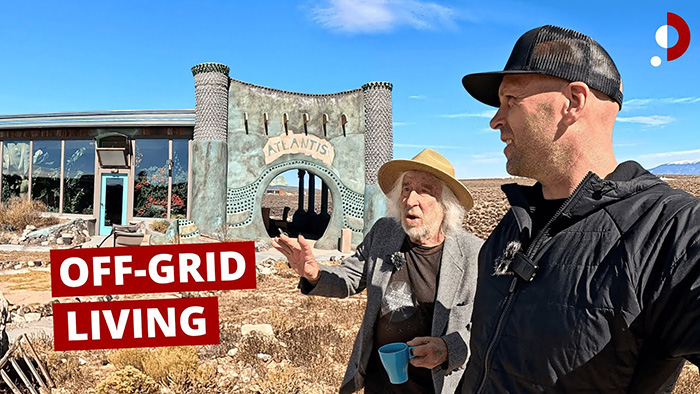
"This is a 640-acre independent Earthship development," he beams as he points out the driver side window to the main structures that make up the community known as Atlantis. "No heating bill, no electric bill, no water bill. This is Wonderland. And there's land, wide open spaces." In the distance we can see one of the buildings, its long, low roofline and glinting windows nestled within great berms of earth.
The 640 acres, we learn, are divided roughly in half: 320 for clustered housing arranged on three-acre circular lots, and 320 left as open land for walking, riding and wildlife. The development, begun some 30 years ago, is nearly built out, with only about a dozen home sites remaining.
At Atlantis, Mike walks Pete through the "biosphere" of one of the dwellings, a self-contained living system that encompasses the entire home. Inside, the air is humid and smells of the bananas, grapes, tangerines and ferns the residents have been growing in long interior planters. These planters also treat greywater from sinks and showers before it's reused to flush toilets. Rainwater harvested from the roof is stored in cisterns; solar panels charge battery banks that power the house. Mike explains how the homes function "like a thermos" by tapping into the heat beneath the ground as well as from the sun. The homes also have fishponds, and some of the inside walls are embedded with discarded glass bottles arranged in tasteful designs.
Pete is surprised at how warm and tropical it is inside, especially given that rainfall in this region averages just seven inches a year. Mike explains how that "measly" seven inches is multiplied as the water is reused within the Earthship. Rainwater is captured from the roof and used first for bathing and washing. It is then filtered through indoor botanical cells that grow food, reused again to flush toilets, and finally directed outdoors to irrigate landscaping. In this way, the Earthship is designed to make the most of every drop.
From Atlantis, Mike drives Pete past several other Earthships scattered across the vast development. There's the high-end "Phoenix," and then the more streamlined "Refuge" model Mike hopes will become his Model T. He also shows Pete some earlier experimental builds. He explains the evolution of the design: how some Earthships are showpieces meant to demonstrate the potential of Earthship design, while others were made to be affordable and mass-producible. Throughout the drive, he keeps returning to his central goal, which is to refine the design until it can be easily permitted, built affordably and widely adopted.
They stop at the partially built Earthship of a close collaborator of Mike's named Deborah. We get a close-up look at its support and retainer walls, which are made from discarded tires packed tightly with rammed earth. Mike describes these dirt-filled tires as 300-pound "bricks" capable of creating enough thermal mass to turn the walls into enormous heat batteries capable of regulating the home's interior temperature without the need for mechanical heating or cooling. He also explains how the walls' massive weight and wide base produce such low ground pressure as to render a conventional concrete foundation unnecessary.
Deborah says she's building her Refuge model slowly and in stages. She doesn't want a mortgage, so she's paying for the construction out of pocket as her budget permits. She wants to own her finished Earthship outright, and she wants her experience to serve as proof that you don't need to spend a fortune on an Earthship.
As Mike shows Pete around, he opens up about his legal battles and his health. We learn that he lost his New Mexico architectural license for pushing the limits of building codes, and that he fought to create the Sustainable Testing Sites Act–signed into law by former governor Bill Richardson–to legalize experimental housing like his Earthships. He's had other victories along the way, but continues to fight many of his old battles.
Mike is married, and despite his age and cancer diagnosis, remains as dedicated as ever to his vision of creating a universally accessible "living machine," which he defines as a home that guarantees the six basics of survival: shelter, electricity, water, food, sewage treatment and waste management. He says he'd like to be able to live another 50 years so he can keep advancing the Earthship movement.
At one point, Mike recalls how he tried to establish Earthships on a 30-acre island in Indonesia. He says the project had to be abandoned due to local corruption and disputes over visas that led to several of his students being detained. Experiences like this have led him to conclude that the United States remains the most viable place to "carve the future" of the Earthship movement.
Mike and Pete eventually part company, leaving Pete to explore the final home on his Earthship tour alone. As the owners of this last Earthship, Brian and Jess, show Pete around, we piece together their story from their banter. We learn that they moved here from Colorado, where they ran a music magazine. Exhausted by their fast-paced city life, they began looking into alternative lifestyles, which led them "down the Earthship rabbit hole," in Jess' words. They've lived in their Earthship full-time for six and a half years now and haven't looked back. They've managed to cut their living expenses to the point that they no longer need to work full time. They now support themselves with part-time gig work, much of it online, and they're able to take leisurely month-long vacations. They relish the autonomy and freedom their Earthship has given them.
As Pete enters the home, he's struck by the calming scents of rosemary and lemongrass from the garden inside. This garden also has figs, grapes and bananas, all watered by the home's greywater system. Brian and Jess show Pete the system of vents they use to change the temperature inside the home, as well as a few modern additions they've made, including a dishwasher and an AC-powered refrigerator, both run on solar energy. Outside there's a garage, a wood-fired sauna, a greenhouse and a fishpond whose water is filtered through a system of planted troughs.
As they talk about their home's design, Brian reflects on how it addresses some of the common criticisms of Earthships. "I think the design behind this," he says, "was Mike kind of saying something to the naysayers, the people who said, you know, 'You can't have a family of four in here.' Well, you easily could. 'You don't have enough storage.' Well, he put in a garage and a bunch of closets and stuff like that."
"All right, there we go," says a visibly excited Pete as he closes out the video. "A unique way of living out here in the New Mexico desert."
Mainstream coverage of off-grid, self-sustaining communities like the one featured in this video tends to be glib and sensational (focusing, for example, on "trash homes"). It's so much rarer to see in-depth coverage of the full social, technical and ecological aspects of such communities, or intimate glimpses into residents' daily lives and motivations. It's great to see Santenello working to fill that gap.